German Jordanian University (GJU) is a public university located in Mushaqqar. It was created in 2005 by a Royal Decree in accordance with a memorandum of understanding reached between the Ministry of Higher Education and Scientific Research of the Hashemite Kingdom of Jordan and the Federal Ministry of Education and Research of the Federal Republic of Germany. The University is a “replica” of the German applied-sciences model, characterized by focusing on applying knowledge into practice and promoting knowledge transfer to real life situations. GJU focuses on offering undergraduate and graduate programs of the highest quality through 8 different colleges that …

Jordan University of Science and Technology (JUST) is public leading highly reputable ranked academic institution. In 1986, the JUST was founded on the outskirts of Irbid, 70 kilometres north Amman, the capital of Jordan. The main purpose of establishing JUST, autonomous national institute of higher education, was graduating bundles of outstanding professionals in specialties that matched the needs of Jordan as well as the region. The student body has increased by more than ten folds of the original one in 1986. Currently, the school has more than 800 full-time faculty members, with 20,000 undergraduate and 1800 graduate students, in contrast …
Zarqa University (ZU) was founded in 1994 with just six colleges and 150 students enrolled in twenty majors. Since then, the university has grown exponentially, adding many more colleges, undergraduate programs, and graduate programs, attracting students from over 37 nationalities across the globe, creating a rich and unique blend of cultures. Today, ZU comprises 13 colleges, 3 deanships, 38 undergraduate programs, and 11 master’s programs, with more than 25,000 graduates. Located in Zarqa, a relatively underprivileged region, the university aims to serve and empower the local community to thrive and improve living conditions. ZU promotes itself as an institution that …
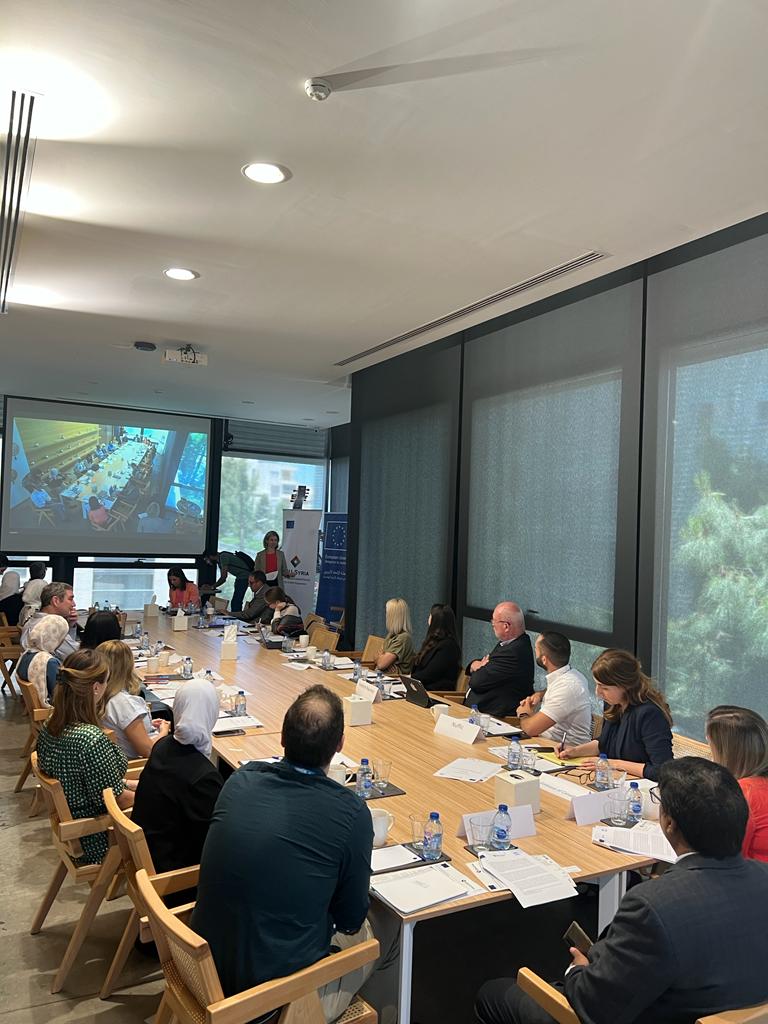
A comprehensive second roundtable discussion was held by EDU-SYRIA and UNHCR on Monday, 5th of June 2023, focusing on the critical role of higher education and Technical and Vocational Education and Training (TVET) programs in empowering refugees and enhancing their self-reliance. The discussions, held with key stakeholders including; British Council, Goethe Institute, The World Bank, Abdulla Al Ghurair Foundation (AGF), The European Union, NUFFIC, The Friedrich Naumann Foundation, DAAD, UNICEF, Embassy of Canada, Australian Embassy, German Embassy and Yarmouk University, aimed to identify unmet needs, highlight opportunities, and foster collaboration to address the challenges faced by refugee students. This second …
The High School Summer Program (HSSP) gives Syrian refugee and vulnerable Jordanian high schoolers a first taste of college life before they ever apply. Delivered by GJU together with partner institutions and specialised providers each summer, the program combines university and TVET exposure, hands-on STEAM activities, and teamwork exercises designed to build the study skills, digital literacy, critical thinking, and confident communication students will need to succeed, in school, in college, and eventually in their careers. Beyond academic orientation, participants gain practical information on admissions, scholarships, and bridging routes into further education, and are paired with EDU-SYRIA alumni who serve …
ETSP equips Syrian refugees and vulnerable Jordanians to launch their own businesses, delivered by GJU’s Deanship of Innovation, Technology Transfer and Entrepreneurship (DI-TECH) alongside a network of employers, incubators, and mentors. The program combines entrepreneurship bootcamps with business validation, incubation, mentoring, and career services, giving particular attention to home-based, small-scale, social, green, and remote-work-compatible ventures, business models well suited to the constraints many beneficiaries face. Participants form teams that move through a structured, competitive pathway: from initial team formation and customer discovery, through business modelling, financial literacy, legal awareness, and digital marketing, to a bootcamp stage where the strongest teams …
The Bottlenecks Alleviation Program (BAP) funds a set of flagship projects designed to close specific, evidence-based gaps between what Syrian refugee and vulnerable Jordanian students learn and what the labour market actually demands. Rather than following a fixed curriculum, BAP issues targeted calls, or procures specialized training directly, based on current labour-market evidence, prioritizing applied digital skills, green growth, healthcare support, smart agriculture, energy efficiency, and advanced manufacturing, alongside other approved areas of demand. Every funded project must involve employers directly, whether through practical assessment, internships, or project-based work, ensuring training translates into real job prospects rather than credentials alone. …
Two considerations shaped the design of the Six-Month Labour Market Oriented Course Scholarship Program (LMP) under EDU-SYRIA III. The first was market evidence: before launch, the curriculum was built on survey research and industry focus groups, developed jointly with Luminus Technical University College (LTUC), the Amman Chamber of Industry, the Amman Chamber of Commerce, and the Technical and Vocational Skills Development Commission (TVSDC), with EDU-SYRIA involved throughout. This produced a set of short, practical courses in fields such as computerized decoration and carpentry, cooling and air conditioning engineering, electrical installations and control machines, industrial fashion design, and mobile phone maintenance. …
The Teacher Certificate Scholarship Program (TCSP) invests directly in practicing teachers already working in Jordanian public schools, equipping them with formal pedagogical preparation many never received on entering the profession, a gap common across the region and one that research shows can be a genuine turning point in a teacher’s career. Delivered by the Queen Rania Teacher Academy (QRTA) in partnership with the German Jordanian University (GJU), the program is highly competitive, with a limited number of seats filled each cohort, and centers on QRTA’s STEAM Higher Diploma, blending theoretical grounding with an extensive school-based practicum. The certificate combines three …
The GSSP action offers vulnerable Jordanians and Syrian refugees who already hold a bachelor’s degree a full scholarship to pursue a master’s degree, in specialised fields tied to Jordan’s labour-market, public-service, and recovery needs, such as digital transformation, engineering, water and energy, health, education, business and entrepreneurship, public policy, and green growth. The programme is led by the German Academic Exchange Service (DAAD) and delivered through German Jordanian University (GJU), Jordan University of Science and Technology (JUST), Yarmouk University (YU), and Mu’tah University (MU), with master’s programmes running roughly three years to completion. A master’s degree remains a major launching …